

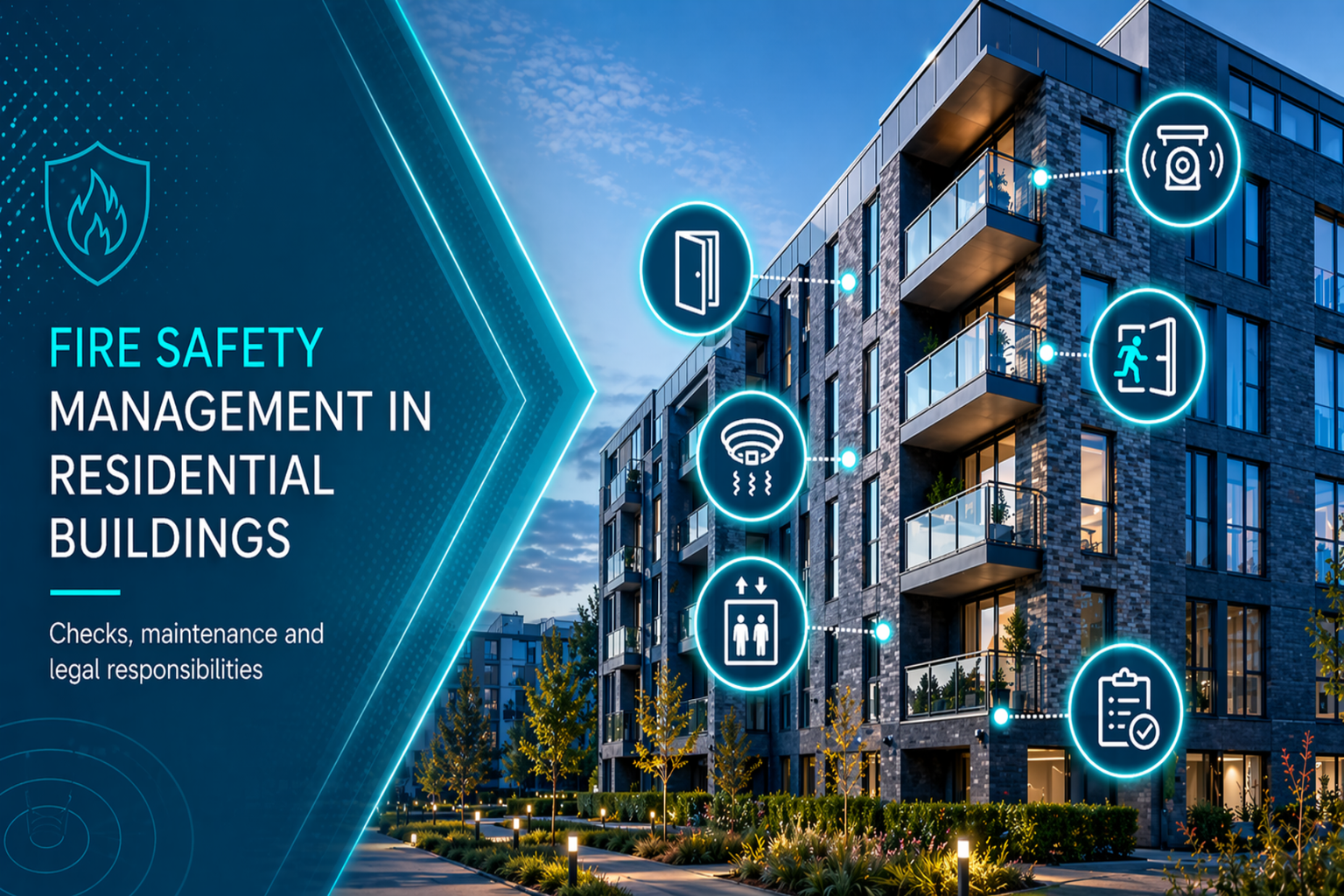
Many people assume residential fire safety management begins and ends with a fire risk assessment.
In practice, the picture is broader than that.
For multi-occupied residential buildings in England, fire safety management can include not only assessment and maintenance of precautions, but also resident information, fire door checks, record-keeping, and building-specific arrangements that become more detailed as height and complexity increase.
That is where many dutyholders become uncertain. The real question is not simply whether a building has fire safety paperwork in place, but whether the management arrangements reflect what actually applies to that building.
What “fire safety management” actually means
In residential buildings, fire safety management is not one single task or document. It is the ongoing process of making sure the building’s fire precautions, communication, routine checks, and management arrangements remain suitable and effective.
In practical terms, that often includes:
- keeping the fire risk assessment under review
- maintaining fire precautions and equipment
- managing fire doors and means of escape
- providing residents with appropriate fire safety information
- ensuring there is a clear process for monitoring issues and acting on them
This is one of the main reasons the subject is often misunderstood. People tend to focus on the assessment itselfwhen in reality, the wider management arrangements are just as important.
Who is usually responsible
In broad terms, the Responsible Person is usually the person or organisation that controls the common parts of the building. That may be the owner, landlord, managing agent, freeholder, resident management company, right-to-manage company, or another party with sufficient control over those areas.
In practice, this means the Responsible Person is usually expected to ensure the building’s fire safety management arrangements are in place and kept under review.
What generally applies in multi-occupied residential buildings
Across multi-occupied residential buildings in England, there are some broad expectations that commonly apply.
- have suitable fire risk assessment arrangements for the common parts
- provide residents with fire safety instructions
- provide residents with information on the importance of fire doors
- ensure fire precautions in the common parts remain effective
- support a management approach that reflects how the building is actually used
This is one of the most important practical points: residential fire safety management is not just about systems. It also includes communication, awareness, and day-to-day control of the building in use.
Where requirements become more specific
This is where confusion often increases.
For multi-occupied residential buildings over 11 metres in height, there are specific fire door checking duties.
For high-rise residential buildings over 18 metres or 7 storeys, additional requirements can apply, including information-sharing with the fire and rescue service, wayfinding signage, and certain monthly system checks where relevant.
So the practical question is not simply, “What does the law say about residential buildings?” It is:
What applies to this building, at this height, with this management arrangement?
|
Practical note: systems that may also need competent inspection and maintenance Fire safety management is not limited to paperwork, instructions and routine checks. Where the building has systems or components that its fire safety arrangements rely on, those need to be inspected, tested, and properly maintained. Where relevant, that may include fire alarm systems, emergency lighting, smoke ventilation systems such as AOVs, fire doors, sprinklers, firefighting lifts or evacuation lifts, risers and other essential fire safety equipment. A sensible management approach usually includes using competent contractorsfor specialist systems, keeping records of tests, servicing, defects, and remedial works, and ensuring faults are addressed promptly. Commonly referenced standards may include BS 5839-1 and BS 5839-6 for fire alarm systems, BS 5266-8 for emergency lighting, BS 8214for fire doors, and BS EN 12845/BS 9251 for sprinkler systems, depending on the installation. The important point is not that every residential building must have every one of these systems. It is where such systems are provided and where the building relies on them; they should be appropriately inspected, tested, serviced, and maintained by competent persons, with records retained where applicable. |
Where people often get this wrong
One of the most common misunderstandings is the idea that fire safety management is just another way of saying “have a fire risk assessment”.
The assessment is central, but it is not the whole picture.
In practice, residential fire safety management also involves ensuring that precautions remain effective, that residents receive the right information, that fire door checks are carried out where required, and that any systems the building relies on are routinely tested, serviced, and maintained.
Another common area of confusion is building height. Some duties apply generally across multi-occupied residential buildings in England, while other duties only arise once the building passes specific thresholds. That is why a one-size-fits-all answer is rarely enough.
A few practical examples
A small block of flats with common parts
In a smaller block, the Responsible Person may need to ensure the common parts are subject to suitable fire risk assessment arrangements, that residents receive the right fire safety information, and that day-to-day management supports the safe use of the building.
A building over 11 metres
Once a residential building exceeds 11 metres, the Responsible Person also needs to consider the specific fire door checking duties that apply. This is often the point at which owners and managing agents realise that residential fire safety management is more than a generic maintenance exercise.
A high-rise residential building
For higher-rise buildings, the management picture becomes more involved again. Information-sharing, signage, and certain monthly checks may all come into play depending on the building. This is where a more structured, building-specific approach becomes especially important.
|
Final thought Fire safety management in residential buildings in England is not just about having a fire risk assessment on file. It is about ensuring the building’s fire precautions, resident information, routine checks, and management arrangements reflect what actually applies to that building. Some duties apply broadly across multi-occupied residential buildings. Others become more specific once particular height thresholds are met. Where the building relies on systems such as alarms, emergency lighting, smoke ventilation, fire doors, or lifts, those systems also need appropriate inspection, testing, servicing, and maintenance. If you are unsure which fire safety management duties apply to your residential building, RSCP Engineering & Consultancy can provide clear, practical advice tailored to the building, its use, and the associated management responsibilities. |